
How dark the sky is at New River: Bortle Class 3, rural sky
The zenith sky here reads 21.75 magnitudes per square arcsecond. That is about 1.3 times the brightness of a pristine natural sky (22.0), the extra coming from artificial light scattered in the air.
Milky Way
The Milky Way still looks complex overhead, with some light pollution near the horizon
Zodiacal light
Zodiacal light is striking after dusk or before dawn but does not reach far up the sky
Faintest naked-eye stars
Magnitude 6.6 to 7.0 overhead
Naked eye
M33 needs averted vision; globulars M4, M5, M15 and M22 are naked-eye objects
At the eyepiece
Bright galaxies and nebulae show well; the faintest objects lose contrast low in the sky
Sky brightness and class come from the World Atlas of Artificial Night Sky Brightness (Falchi et al. 2016, CC BY-NC 4.0), with natural skyglow added. On the night, haze, smoke, humidity and the Moon set the real limit; see every Bortle Class 3 place.
What's up from New River by season
At latitude 36.5°N, the north celestial pole stands 36° above the horizon, close to Polaris. Every star north of declination -54° rises at some time of year. The Milky Way core in Sagittarius climbs to 25° above the southern horizon. These are the constellations well placed, 35° or more above the horizon, at about 10 pm in the middle of each season, brightest first.
January evenings (winter): Auriga, Orion, and Canis Minor
- AurigaOverhead, brightest star Capella
- OrionHigh in the south, brightest star Rigel
- Canis MinorIn the southeast, brightest star Procyon
- TaurusHigh in the southwest, brightest star Aldebaran
- GeminiHigh in the southeast, brightest star Pollux
- Ursa MajorIn the northeast, brightest star Alioth
- PerseusHigh in the northwest, brightest star Mirfak
- AriesIn the west, brightest star Hamal
Also well placed: Cassiopeia, Triangulum, Lynx, Cancer, Monoceros, Camelopardalis.
April evenings (spring): Bootes, Virgo, and Leo
- BootesHigh in the east, brightest star Arcturus
- VirgoIn the southeast, brightest star Spica
- LeoHigh in the southwest, brightest star Regulus
- Ursa MajorHigh in the northwest, brightest star Alioth
- Ursa MinorIn the north, brightest star Polaris
- Corona BorealisIn the east, brightest star Alphecca
- Canes VenaticiOverhead, brightest star Cor Caroli
- LynxIn the northwest, brightest star Alpha Lyncis
Also well placed: Cancer, Crater, Leo Minor, Camelopardalis, Coma Berenices, Sextans.
July evenings (summer): Bootes, Lyra, and Aquila
- BootesHigh in the west, brightest star Arcturus
- LyraOverhead, brightest star Vega
- AquilaIn the southeast, brightest star Altair
- CygnusHigh in the northeast, brightest star Deneb
- Ursa MinorIn the north, brightest star Polaris
- OphiuchusIn the south, brightest star Rasalhague
- Corona BorealisHigh in the west, brightest star Alphecca
- DracoHigh in the north, brightest star Eltanin
Also well placed: Cepheus, Serpens, Hercules, Canes Venatici, Sagitta, Delphinus, Scutum, Vulpecula.
October evenings (fall): Cygnus, Perseus, and Aries
- CygnusHigh in the northwest, brightest star Deneb
- PerseusIn the northeast, brightest star Mirfak
- AriesIn the east, brightest star Hamal
- CetusIn the southeast, brightest star Diphda
- AndromedaOverhead, brightest star Alpheratz
- CassiopeiaHigh in the north, brightest star Schedar
- PegasusHigh in the southwest, brightest star Enif
- CepheusHigh in the north, brightest star Alderamin
Also well placed: Aquarius, Triangulum, Sagitta, Pisces, Delphinus, Lacerta, Equuleus, Vulpecula.
Showpieces from New River through the year
| Sight | Constellation | January | April | July | October |
|---|---|---|---|---|---|
| Andromeda Galaxy (M31) | Andromeda | In the northwest | - | - | Overhead |
| Orion Nebula (M42) | Orion | In the south | - | - | - |
| Pleiades (M45) | Taurus | High in the west | - | - | In the east |
| Double Cluster | Perseus | High in the northwest | - | - | High in the northeast |
| Hercules Cluster (M13) | Hercules | - | In the northeast | Overhead | - |
| Whirlpool Galaxy (M51) | Canes Venatici | - | High in the northeast | In the northwest | - |
| Ring Nebula (M57) | Lyra | - | - | Overhead | In the west |
| Lagoon Nebula (M8) | Sagittarius | - | - | In the south | - |
At about 10 pm on the 15th of each month; a dash means the sight is below 25° then.
Never set from New River
Only skim the southern horizon from New River
Never rise from New River
Where to set up at New River
The coordinates on this page point to New River State Park, at 828 m (2,720 ft): 36.468°N, 81.340°W.
Map data © OpenStreetMap contributors. Open the larger map · Directions. Arrive before dark, park facing away from other observers, and use red light only.
New River among the dark sky places of North Carolina
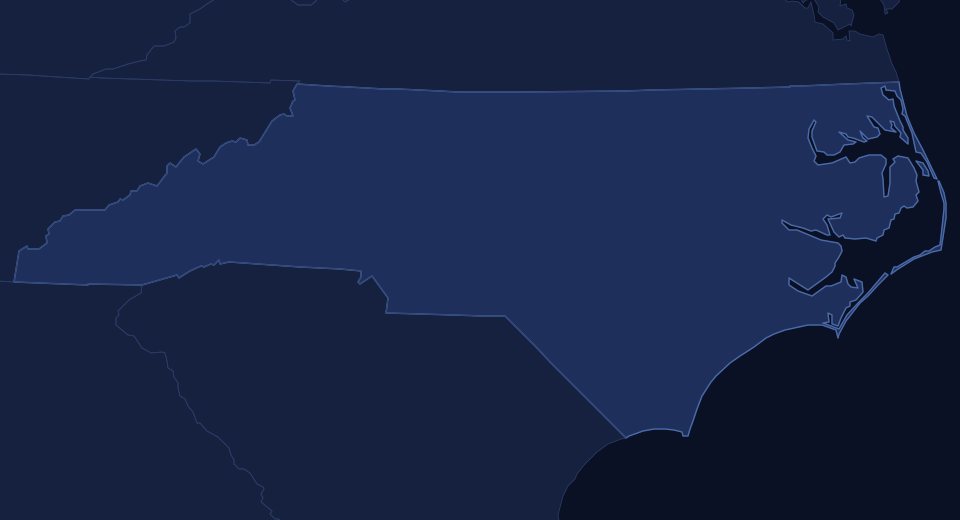
Each dot is a dark sky place, colored by Bortle class; select one for its page. See North Carolina dark sky places for the full list, darkest first.
Camping and lodging at New River
The nearest town with motels or inns is Jefferson, NC. Check the official site for campgrounds and overnight rules; many parks close their gates at night, so ask about after-dark access.
Dark sky places nearest New River
| Place | Where | Bortle | Distance |
|---|---|---|---|
| Grayson Highlands State Park | Virginia | 3 | 24 km (15 mi) |
| Cherokee National Forest | Tennessee | 4 | 66 km (41 mi) |
| Cherokee National Forest | Tennessee | 4 | 66 km (41 mi) |
| Linville Gorge Wilderness | North Carolina | 4 | 81 km (50 mi) |
| Mayland Earth to Sky Dark Sky Park | North Carolina | 4 | 96 km (60 mi) |
| Kings Mountain National Military Park | South Carolina | 4 | 148 km (92 mi) |
| New River Gorge National Park | West Virginia | 4 | 154 km (96 mi) |
| Hominy Valley County Park | North Carolina | 4 | 159 km (99 mi) |
Star parties near New River
| Star party | Near | Distance | Usual timing |
|---|---|---|---|
| Green Bank Star Quest | Green Bank, West Virginia | 256 km (159 mi) | Summer |
| Almost Heaven Star Party | Riverton, West Virginia | 295 km (183 mi) | New-moon weekend in August |
| Shenandoah Night Sky Festival | Luray, Virginia | 343 km (213 mi) | Late summer |
| Cherry Springs Star Party | Coudersport, Pennsylvania | 652 km (405 mi) | June, near new moon |
Planning a trip? Astrotourism in North Carolina puts the dark sky places, observatories, clubs, star parties, planetariums and science centers of the state on one map, with the best night out worked out.
Observatories and astronomy clubs near New River
Observatories within 100 km
- Dark Sky ObservatoryPurlear, North Carolina, 41 km (25 mi), open to the public
- Willis ObservatoryBakersville, North Carolina, 89 km (55 mi), open to the public
- Lucile Miller ObservatoryMaiden, North Carolina, 100 km (62 mi), open to the public
Nearest astronomy clubs
- Catawba Valley Astronomy ClubConover, North Carolina, 83 km (51 mi)
- Piedmont Amateur AstronomersStatesville, North Carolina, 84 km (52 mi). Meets 1st Thursday monthly, 7-9 pm
- Forsyth Astronomical SocietyWinston-Salem, North Carolina, 106 km (66 mi). Meets 2nd Wednesday monthly, 7:30 pm
- Bays Mountain Astronomy ClubKingsport, Tennessee, 113 km (70 mi). Meets 1st Friday monthly, 7 pm
- Cleveland County Astronomical SocietyBoiling Springs, North Carolina, 139 km (87 mi). Meets 4th Thursday monthly, 7:30 pm
See observatories and astronomy clubs in North Carolina. Local clubs often hold their star parties at dark sky places like this one.
New River record
Every value in the dark sky places dataset for New River
| Park | 461 |
|---|---|
| Name | New River |
| TypeLong | State Park |
| Type1 | SP |
| Bortle | 3 |
| Statelong | North Carolina |
| State | NC |
| Web | https://www.ncparks.gov/new-river-state-park/home |
| Lat | 36.46768 |
| Lon | -81.34035 |
| LatLonSpot | New River State Park |
| Elevation_m | 828 |
| LandManager | North Carolina Division of Parks and Recreation |
| Status | Open |
| Lodging | Jefferson, NC |
| Sources | https://en.wikipedia.org/wiki/New_River_State_Park |
| SQM | 21.75 |
From the site's dark sky places dataset (parks_q426). The sky by season is computed from the coordinates.