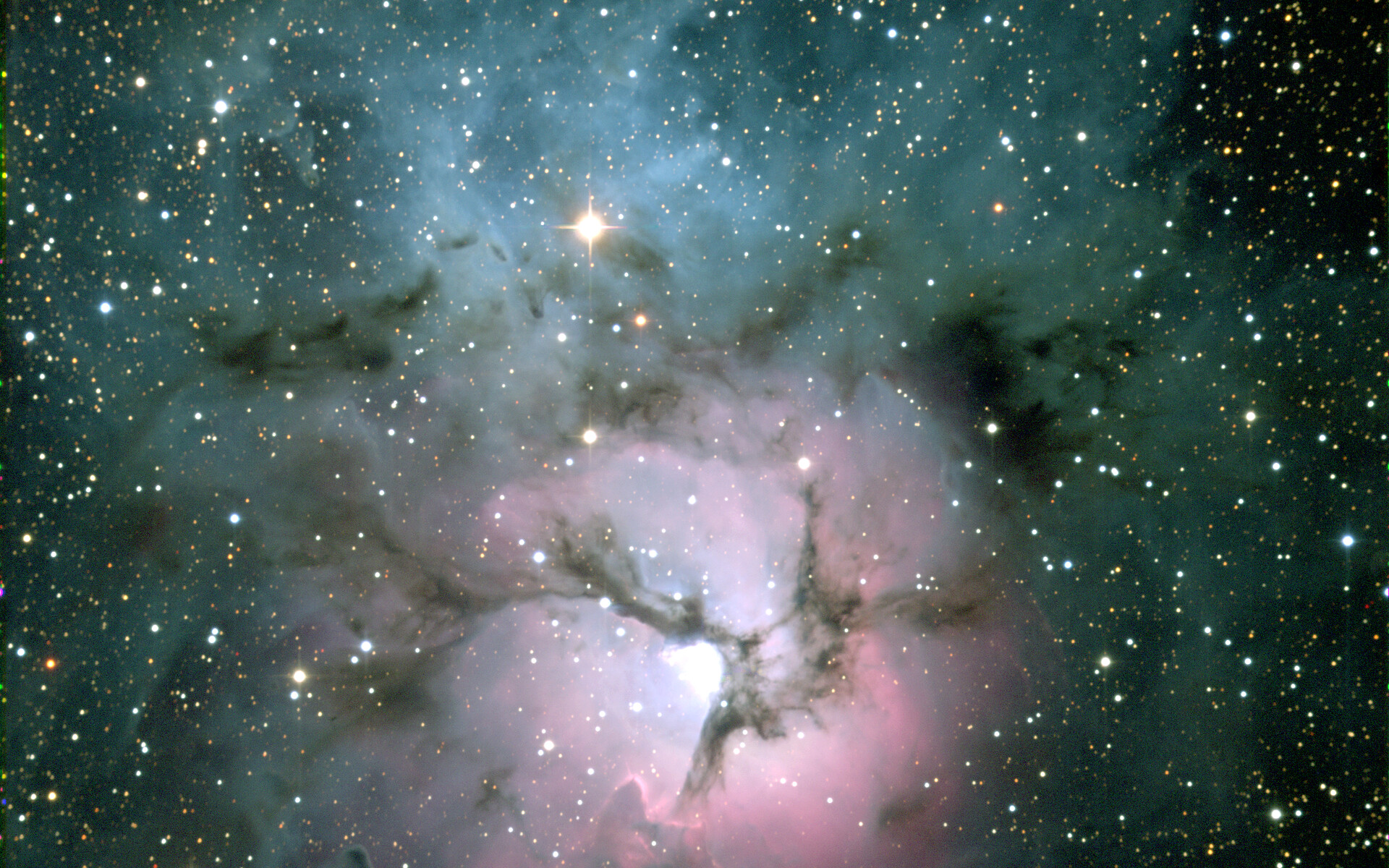
Trifid Nebula is a nebula w/cluster in Sagittarius, 4,080 light-years away
Trifid Nebula (M20, NGC 6514, Herschel 400 no. 336, LBN 27, MWSC 2789, Sh2-30) is a nebula w/cluster in the constellation Sagittarius, 4,080 light-years away. It shines at magnitude 6.3 and spans 28′ of sky, about 33 light-years across. It is an easy target in binoculars, and it is highest in the evening sky in August.
Nebula: a cloud of gas and dust. Emission nebulae glow on their own, lit by ultraviolet light from hot young stars; reflection nebulae shine by starlight scattered from dust; dark nebulae block the light behind them.
Trifid Nebula is Sh2-30 in the Sharpless catalog
Stewart Sharpless listed it in his catalog of H II regions (1959), drawn from the red and blue prints of the Palomar Sky Survey. He rated each region's brightness on a scale of 1 to 3; Sh2-30 is bright (class 3 of 3). It is also listed as LBN 27, Cr 360, RCW 147, Gum 76.
Trifid Nebula is RCW 147 in the RCW catalog of southern H-alpha regions
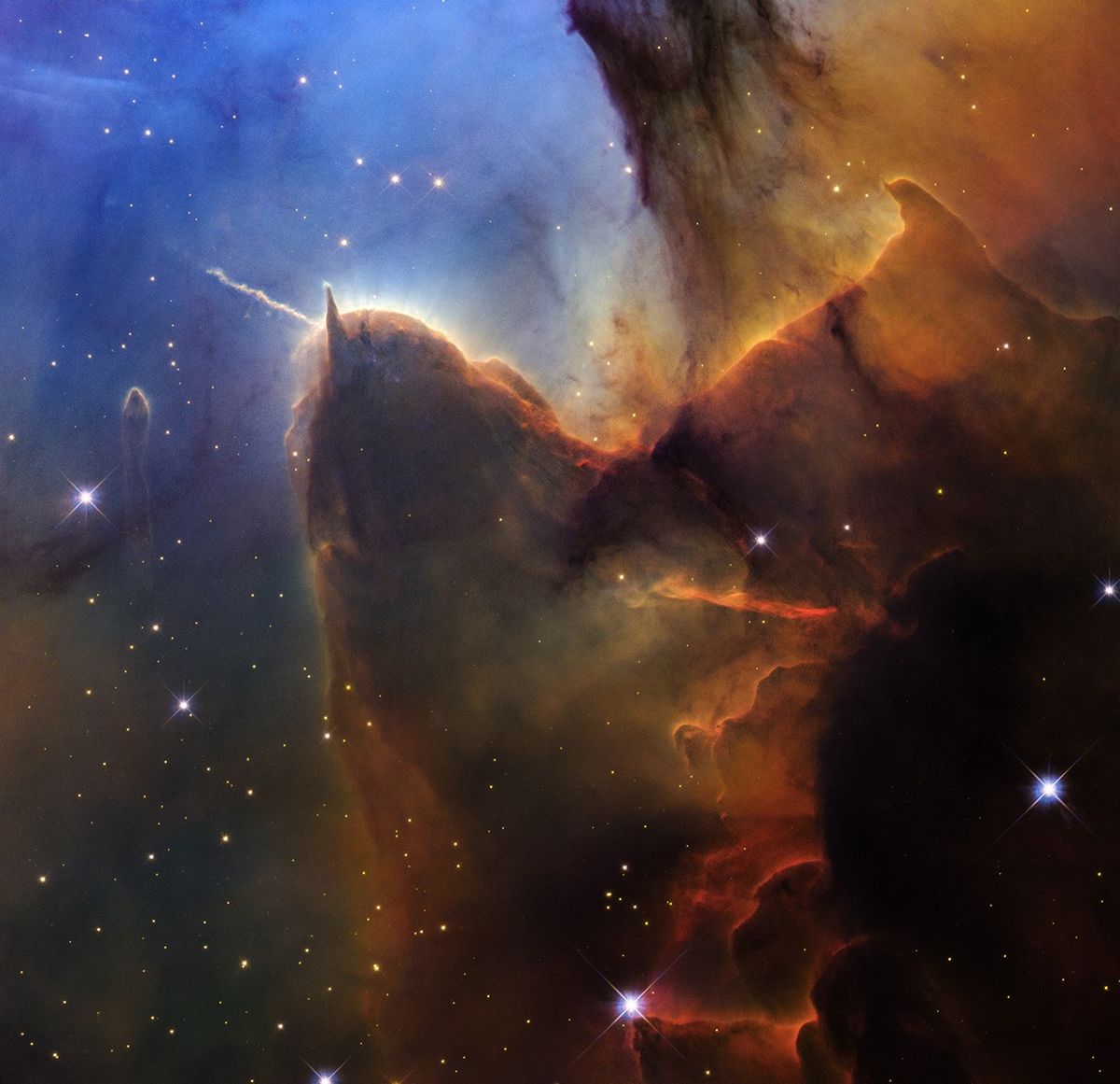
Stellar jet. A narrow jet of gas about 0.75 light-year long, shot out by a young star buried in the top of the cloud. It is cataloged as HH 399.
Finger of gas. A finger of denser gas that survives as starlight erodes the cloud around it. A young star may be forming at its tip.
Glowing edge. The bright rim is where ultraviolet light from HD 164492A, the massive star at the heart of the Trifid, strikes the dense cloud and boils its surface away.
Finding Trifid Nebula from Kaus Borealis
Trifid Nebula lies 6.3° west of Kaus Borealis, the magnitude 2.8 star. Three fingers held at arm's length cover about 5°.
Trifid Nebula is highest in the evening in August
The chart gives its height above the horizon at 9 pm through the year, from 60°N to 40°S. It can be seen from the whole southern hemisphere and north to about 67°N, and never sets south of 67°S.
Trifid Nebula is 4,080 light-years away
The light seen from Trifid Nebula tonight left it about 4,080 years ago. It ranks 26 of 109 by distance among the 110 Messier objects. Distance source: Gaia parallaxes, Kuhn et al. 2021 (Trifid).