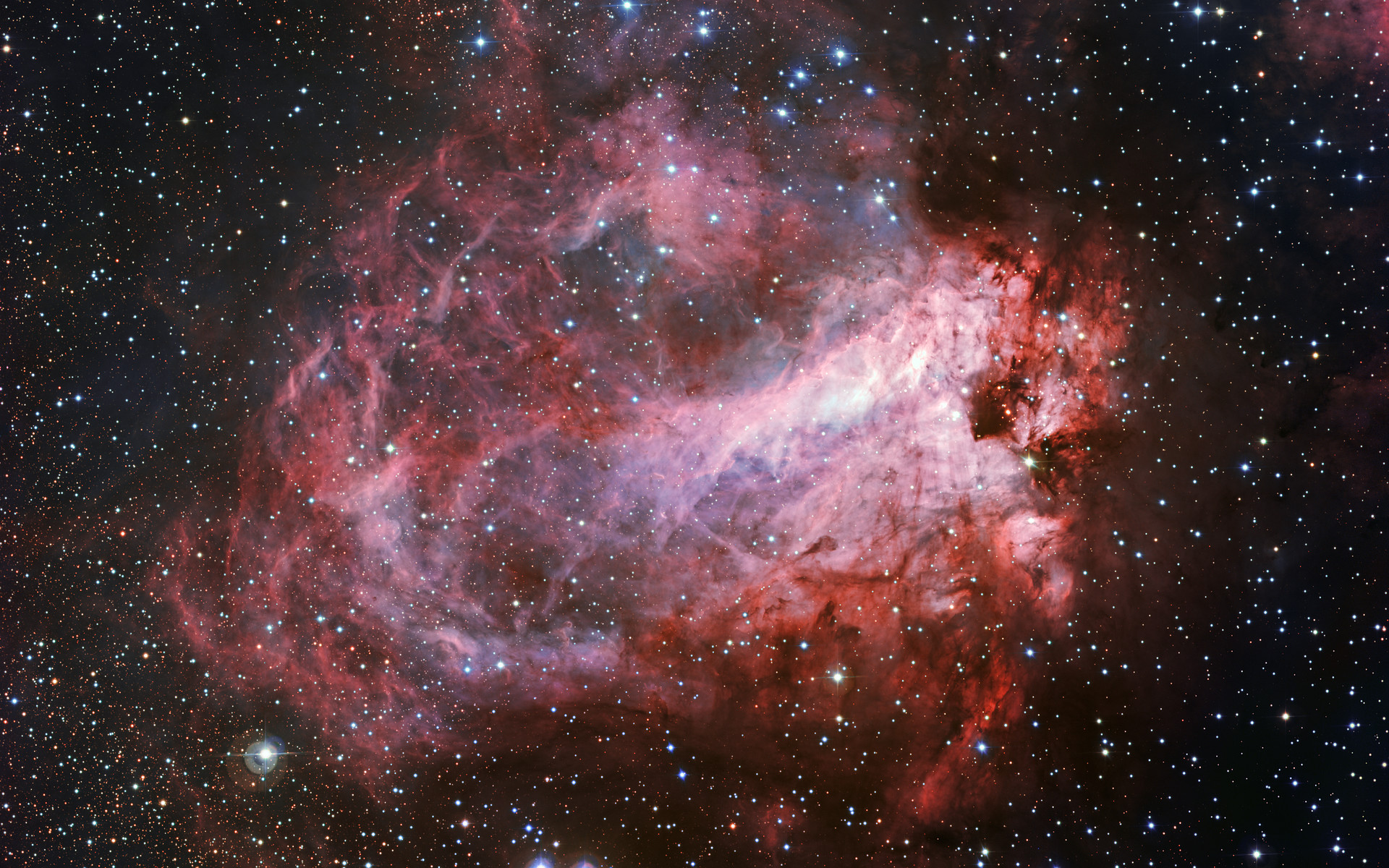
Image of Omega Nebula

Image: ESO, CC BY 4.0

M17 · NGC 6618 · LBN 60

Omega Nebula

Diffuse nebula in Sagittarius

Bright bar of glowing gas with a hook at one end, often seen as a swan. One of the brightest nebulae in binoculars.

SAGITTARIUS

The box shows where Omega Nebula sits in Sagittarius.

Constellation
SagittariusSgr
Magnitude
7.0visual
Size
11′about 17 light-years
Distance
5,460 lylight-years
Best month
Augustat 9 pm
Best with
Binoculars

Omega Nebula is a diffuse nebula in Sagittarius, 5,460 light-years away

Omega Nebula (M17, NGC 6618, LBN 60, MWSC 2896, Sh2-45, RCW 160) is a diffuse nebula in the constellation Sagittarius, 5,460 light-years away. It shines at magnitude 7.0 and spans 11′ of sky, about 17 light-years across. It is an easy target in binoculars, and it is highest in the evening sky in August.

Nebula: a cloud of gas and dust. Emission nebulae glow on their own, lit by ultraviolet light from hot young stars; reflection nebulae shine by starlight scattered from dust; dark nebulae block the light behind them.

Omega Nebula is Sh2-45 in the Sharpless catalog

Stewart Sharpless listed it in his catalog of H II regions (1959), drawn from the red and blue prints of the Palomar Sky Survey. He rated each region's brightness on a scale of 1 to 3; Sh2-45 is bright (class 3 of 3). It is also listed as RCW 160, LBN 60, Cr 377.

Omega Nebula is RCW 160 in the RCW catalog of southern H-alpha regions

A. W. Rodgers, C. T. Campbell and J. B. Whiteoak listed it in their catalog of H-alpha emission regions in the southern Milky Way (1960), from photographs taken at Mount Stromlo Observatory.

Omega Nebula is Gum 81 in Colin Gum's survey of southern H II regions

Colin Gum listed it in his survey of H II regions of the southern Milky Way (1955), the first photographic survey of the southern emission nebulae, made at Mount Stromlo Observatory.

Omega Nebula features on the image

Each number on the image marks one feature.

  1. Bright bar. The brightest band of gas, the swan's body, is lit by NGC 6618, a cluster of young massive stars mostly hidden behind dust. Their ultraviolet light makes the hydrogen glow.
  2. M17 SW. A dark, dense cloud of cold gas on the nebula's southwest edge. Light from the cluster is eating into it, and new stars are forming inside.
  3. Rose glow. The rose color is hydrogen, ionized by the cluster and glowing red at 656 nm. M17 is one of the brightest star-forming regions in the Milky Way, about 5,500 light-years away.

Finding Omega Nebula from Kaus Borealis

Kaus Borealis M17 SAGITTARIUS

Omega Nebula lies 9.4° north of Kaus Borealis, the magnitude 2.8 star. A fist held at arm's length covers about 10°.

Omega Nebula is highest in the evening in August

JAN FEB MAR APR MAY JUN JUL AUG SEP OCT NOV DEC 60°N JAN at 60°N: -42° high at 9 pm FEB at 60°N: -46° high at 9 pm MAR at 60°N: -40° high at 9 pm APR at 60°N: -27° high at 9 pm MAY at 60°N: -13° high at 9 pm JUN at 60°N: 1° high at 9 pm JUL at 60°N: 11° high at 9 pm AUG at 60°N: 14° high at 9 pm SEP at 60°N: 9° high at 9 pm OCT at 60°N: -2° high at 9 pm NOV at 60°N: -16° high at 9 pm DEC at 60°N: -30° high at 9 pm 50°N JAN at 50°N: -50° high at 9 pm FEB at 50°N: -56° high at 9 pm MAR at 50°N: -47° high at 9 pm APR at 50°N: -30° high at 9 pm MAY at 50°N: -11° high at 9 pm JUN at 50°N: 7° high at 9 pm JUL at 50°N: 20° high at 9 pm AUG at 50°N: 24° high at 9 pm SEP at 50°N: 17° high at 9 pm OCT at 50°N: 4° high at 9 pm NOV at 50°N: -15° high at 9 pm DEC at 50°N: -34° high at 9 pm 40°N JAN at 40°N: -57° high at 9 pm FEB at 40°N: -66° high at 9 pm MAR at 40°N: -53° high at 9 pm APR at 40°N: -31° high at 9 pm MAY at 40°N: -8° high at 9 pm JUN at 40°N: 13° high at 9 pm JUL at 40°N: 28° high at 9 pm AUG at 40°N: 34° high at 9 pm SEP at 40°N: 26° high at 9 pm OCT at 40°N: 9° high at 9 pm NOV at 40°N: -13° high at 9 pm DEC at 40°N: -36° high at 9 pm 30°N JAN at 30°N: -63° high at 9 pm FEB at 30°N: -75° high at 9 pm MAR at 30°N: -57° high at 9 pm APR at 30°N: -31° high at 9 pm MAY at 30°N: -6° high at 9 pm JUN at 30°N: 18° high at 9 pm JUL at 30°N: 37° high at 9 pm AUG at 30°N: 44° high at 9 pm SEP at 30°N: 33° high at 9 pm OCT at 30°N: 13° high at 9 pm NOV at 30°N: -11° high at 9 pm DEC at 30°N: -37° high at 9 pm 20°N JAN at 20°N: -65° high at 9 pm FEB at 20°N: -84° high at 9 pm MAR at 20°N: -59° high at 9 pm APR at 20°N: -30° high at 9 pm MAY at 20°N: -3° high at 9 pm JUN at 20°N: 24° high at 9 pm JUL at 20°N: 45° high at 9 pm AUG at 20°N: 54° high at 9 pm SEP at 20°N: 41° high at 9 pm OCT at 20°N: 18° high at 9 pm NOV at 20°N: -9° high at 9 pm DEC at 20°N: -36° high at 9 pm 10°N JAN at 10°N: -64° high at 9 pm FEB at 10°N: -82° high at 9 pm MAR at 10°N: -58° high at 9 pm APR at 10°N: -28° high at 9 pm MAY at 10°N: -0° high at 9 pm JUN at 10°N: 28° high at 9 pm JUL at 10°N: 52° high at 9 pm AUG at 10°N: 64° high at 9 pm SEP at 10°N: 47° high at 9 pm OCT at 10°N: 22° high at 9 pm NOV at 10°N: -7° high at 9 pm DEC at 10°N: -35° high at 9 pm 0° JAN at 0°: -60° high at 9 pm FEB at 0°: -73° high at 9 pm MAR at 0°: -54° high at 9 pm APR at 0°: -26° high at 9 pm MAY at 0°: 3° high at 9 pm JUN at 0°: 32° high at 9 pm JUL at 0°: 59° high at 9 pm AUG at 0°: 73° high at 9 pm SEP at 0°: 53° high at 9 pm OCT at 0°: 25° high at 9 pm NOV at 0°: -4° high at 9 pm DEC at 0°: -32° high at 9 pm 10°S JAN at 10°S: -54° high at 9 pm FEB at 10°S: -63° high at 9 pm MAR at 10°S: -49° high at 9 pm APR at 10°S: -22° high at 9 pm MAY at 10°S: 5° high at 9 pm JUN at 10°S: 35° high at 9 pm JUL at 10°S: 63° high at 9 pm AUG at 10°S: 83° high at 9 pm SEP at 10°S: 56° high at 9 pm OCT at 10°S: 28° high at 9 pm NOV at 10°S: -1° high at 9 pm DEC at 10°S: -28° high at 9 pm 20°S JAN at 20°S: -46° high at 9 pm FEB at 20°S: -54° high at 9 pm MAR at 20°S: -42° high at 9 pm APR at 20°S: -18° high at 9 pm MAY at 20°S: 8° high at 9 pm JUN at 20°S: 36° high at 9 pm JUL at 20°S: 64° high at 9 pm AUG at 20°S: 85° high at 9 pm SEP at 20°S: 58° high at 9 pm OCT at 20°S: 30° high at 9 pm NOV at 20°S: 2° high at 9 pm DEC at 20°S: -24° high at 9 pm 30°S JAN at 30°S: -38° high at 9 pm FEB at 30°S: -44° high at 9 pm MAR at 30°S: -34° high at 9 pm APR at 30°S: -14° high at 9 pm MAY at 30°S: 10° high at 9 pm JUN at 30°S: 36° high at 9 pm JUL at 30°S: 62° high at 9 pm AUG at 30°S: 76° high at 9 pm SEP at 30°S: 56° high at 9 pm OCT at 30°S: 31° high at 9 pm NOV at 30°S: 5° high at 9 pm DEC at 30°S: -19° high at 9 pm 40°S JAN at 40°S: -29° high at 9 pm FEB at 40°S: -34° high at 9 pm MAR at 40°S: -26° high at 9 pm APR at 40°S: -9° high at 9 pm MAY at 40°S: 12° high at 9 pm JUN at 40°S: 36° high at 9 pm JUL at 40°S: 56° high at 9 pm AUG at 40°S: 66° high at 9 pm SEP at 40°S: 52° high at 9 pm OCT at 40°S: 31° high at 9 pm NOV at 40°S: 7° high at 9 pm DEC at 40°S: -13° high at 9 pm below horizon low 20-40° 40-60° overhead-ish

The chart gives its height above the horizon at 9 pm through the year, from 60°N to 40°S. It can be seen from the whole southern hemisphere and north to about 74°N, and never sets south of 74°S.

Omega Nebula is 5,460 light-years away

The light seen from Omega Nebula tonight left it about 5,460 years ago. It ranks 33 of 109 by distance among the 110 Messier objects. Distance source: NGC 6618 Gaia DR3 1,675 pc (2023).

Objects within 6° of Omega Nebula

Omega Nebula catalog data

FieldValue
DesignationsM17, NGC 6618, LBN 60, MWSC 2896, Sh2-45, RCW 160, Gum 81
Typediffuse nebula
ConstellationSagittarius
Right ascension (J2000)18h 20.8m
Declination (J2000)-16° 10′
Magnitude7.0
Apparent size11′
True size17 light-years
Distance5,460 light-years (NGC 6618 Gaia DR3 1,675 pc (2023))
Best monthAugust
Best withBinoculars
Messier marathon order91