
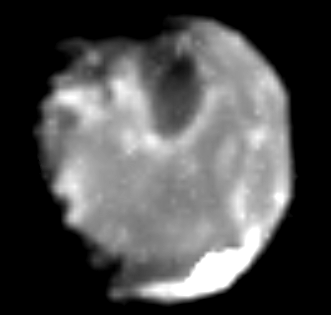

Amalthea is the reddest object in the solar system and orbits inside Jupiter's rings
Amalthea is an elongated, dark red moon about 250 km long that orbits only 181,000 km from Jupiter's center, inside the faint gossamer ring it helps feed. Edward Barnard found it in 1892, the last moon discovered by eye at a telescope. Its density is so low that it is probably a loose pile of rubble and ice, which suggests it formed farther from Jupiter and was moved inward.
How to see Amalthea
At magnitude 14 and so close to Jupiter, Amalthea is a target only for large telescopes and cameras with Jupiter masked.
Amalthea and its neighbors around Jupiter
| Moon | Diameter | Distance | Orbit |
|---|---|---|---|
| Metis | 43 km | 128,000 km | 7.1 hours |
| Adrastea | 16.4 km | 129,000 km | 7.2 hours |
| Amalthea | 167 km | 181,400 km | 12.0 hours |
| Thebe | 98.6 km | 221,900 km | 16.2 hours |
| Io | 3,643.2 km | 421,800 km | 1.8 days |
| Europa | 3,121.6 km | 671,100 km | 3.5 days |
| Ganymede | 5,262.4 km | 1.1 million km | 7.2 days |
| Callisto | 4,820.6 km | 1.9 million km | 16.7 days |
Amalthea physical and orbital data
Every value in the moons dataset for Amalthea
| Parent | Jupiter |
| Group | Inner |
| Diameter | 167 km |
| Distance from planet | 181,400 km |
| Orbital period | 0.499918 days |
| Inclination | 0.4 ° |
| Eccentricity | 0.003 |
| Retrograde orbit | no |
| Magnitude | 13.8 |
| Discovered | 1892 |
| Discoverer | E. E. Barnard |
From the site's moons dataset (moons_q426), which follows JPL's satellite tables and lists a source for every row.