
Can you visit UF Campus Teaching Observatory? Yes
Free public nights Fridays 8:30-10 pm when classes are in session (closed summer); park in garage 5 or 14.
A public night at an observatory usually starts at dusk with a short talk, then a line at the eyepiece of the main telescope for the Moon, a planet or a bright cluster, with volunteers' smaller telescopes set up outside. Dress for the night air even in summer: domes are not heated, so the telescope stays at outside temperature. Many nights sell out or cancel for clouds, so check the observatory's site on the day.
What UF Campus Teaching Observatory observes
The list does not describe the instruments at UF Campus Teaching Observatory yet; the official site has them.
How dark the sky is at UF Campus Teaching Observatory
UF Campus Teaching Observatory has no Bortle rating in the list yet. The scale below shows what each class looks like.
Sky brightness and class come from the World Atlas of Artificial Night Sky Brightness (Falchi et al. 2016, CC BY-NC 4.0), with natural skyglow added, at the coordinates below. Research telescopes are often sited on mountains above the haze, so the real sky can be darker than the map suggests.
UF Campus Teaching Observatory among the observatories of Florida
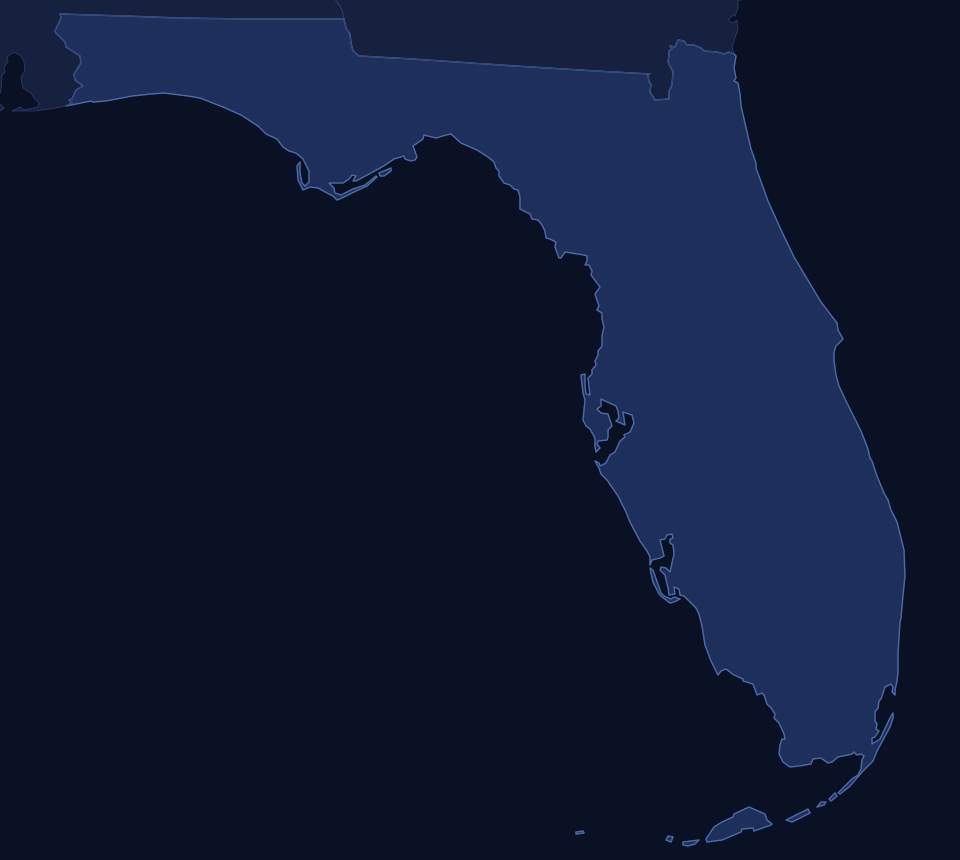
Green dots are observatories open to the public, blue dots research or private sites, squares dark sky places; select one for its page. See Florida observatories for the full list.
The coordinates on this page point to zip 32611 (approximate): 29.681°N, 82.354°W.
Map data © OpenStreetMap contributors. Open the larger map · Directions. Mountain observatory roads are often gated after dark; go only on a scheduled public night.
Dark sky places, observatories and clubs near UF Campus Teaching Observatory
Nearest dark sky places
| Place | Where | Bortle | Distance |
|---|---|---|---|
| Osceola National Forest | Florida | 4 | 63 km (39 mi) |
| Ocala National Forest | Florida | 4 | 79 km (49 mi) |
| Cedar Key Scrub State Reserve | Florida | 2 | 86 km (53 mi) |
| Cedar Key | Florida | 3 | 87 km (54 mi) |
| John M. Bethea State Forest | Florida | 3 | 91 km (57 mi) |
| Suwannee River Wilderness Trail | Florida | 4 | 110 km (68 mi) |
Other observatories open to the public within 150 km
- Rosemary Hill ObservatoryBronson, Florida, 37 km (23 mi). Free public night open houses a few times a year (e.g. Sat 7 Nov 2026, 7-10 pm); free Eventbrite ticket required
Astronomy clubs within 150 km
- Alachua Astronomy ClubGainesville, Florida, 7 km (5 mi). Meets 2nd Tuesday monthly (except Dec), 7 pm
- Northeast Florida Astronomical SocietyJacksonville, Florida, 98 km (61 mi). Meets Monthly general meeting Friday at FSCJ Kent Campus, Building E
- Ancient City Astronomy ClubSt. Augustine, Florida, 101 km (63 mi). Meets Usually 2nd Sunday monthly, dinner 4 pm
Star parties near UF Campus Teaching Observatory
| Star party | Near | Distance | Usual timing |
|---|---|---|---|
| Orange Blossom Special | Dade City, Florida | 152 km (94 mi) | Winter new moon |
| Winter Star Party | Scout Key, Florida | 569 km (353 mi) | Winter new moon |
| Midsouth Stargaze | French Camp, Mississippi | 780 km (484 mi) | Spring |
Planning a trip? Astrotourism in Florida puts the dark sky places, observatories, clubs, star parties, planetariums and science centers of the state on one map, with the best night out worked out.
UF Campus Teaching Observatory record
Every value in the observatories dataset for UF Campus Teaching Observatory
| ID | 216 |
|---|---|
| Name | UF Campus Teaching Observatory |
| Address | Between physics and engineering buildings, University of Florida |
| City | Gainesville |
| State | FL |
| Zip | 32611 |
| Country | USA |
| Web | https://www.astro.ufl.edu/outreach/teaching-public-observatory |
| Public | y |
| Lat | 29.68130 |
| Lon | -82.35390 |
| LatLonSpot | zip 32611 (approximate) |
| Status | Active |
| PublicNote | Free public nights Fridays 8:30-10 pm when classes are in session (closed summer); park in garage 5 or 14 |
| Sources | https://www.astro.ufl.edu/outreach/teaching-public-observatory |
From the site's observatories dataset (observatories_q426). Distances are computed from the coordinates.