
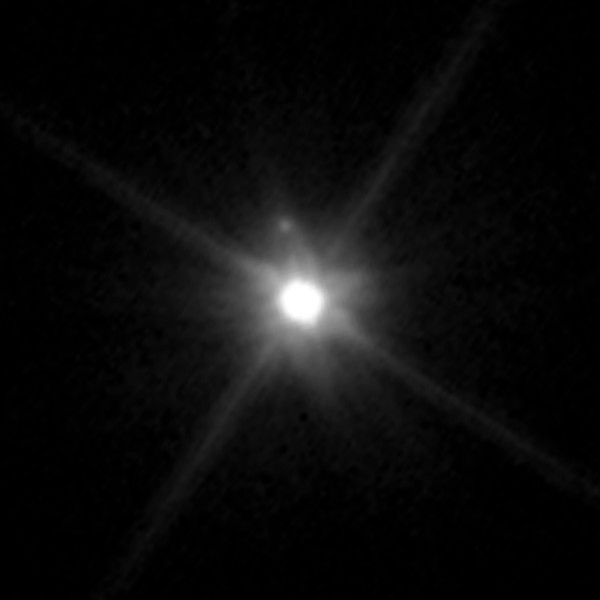

Makemake is the second-brightest object in the Kuiper Belt after Pluto
Makemake is about 1,430 km across and covered in reddish methane and ethane ice. Mike Brown's team found it on March 31, 2005, just after Easter, and it is named for the creator god of the Rapa Nui people of Easter Island. A stellar occultation in 2011 showed it has almost no atmosphere, unlike Pluto. Hubble found its small, dark moon, nicknamed MK2, in 2016.
It orbits between 38 and 53 AU from the Sun every 306 years.
Makemake surface features on the image
Each number on the image marks one feature.
- MK2. A small, dark moon found by Hubble in 2016, about 1,300 times fainter than Makemake.
What is known about the surface of Makemake
Atmosphere
none detected (2011 occultation)
Reflectivity
reflects about 80% of sunlight
Day
22.83 hours
Makemake compared with Pluto
Pluto is the yardstick for the outer solar system: 2,376 km across, 39.5 AU from the Sun on average, on a 248-year orbit.
Makemake has one known moon, MK2
A moon's orbit gives the mass of the body it circles, which is how the masses of distant dwarf planets are known.
| Moon | Diameter | Distance | Orbit | Found |
|---|---|---|---|---|
| MK2 | 175 km | 22,250 km | 12.4 days | 2015 |
How to see Makemake
Makemake reaches about magnitude 15.8 at its brightest. That is within reach of a 12-inch or larger telescope with a detailed chart, or of a modest telescope with a camera; confirm it by its slow motion over a few nights.
Makemake among the dwarf planets and distant worlds
Dwarf planets and candidates beyond Neptune, by distance27
| Name | Region | Average distance (AU) | Diameter (km) |
|---|---|---|---|
| Pluto | Kuiper Belt | 39.24 | 2,376 |
| Orcus | Kuiper Belt | 39.34 | 910 |
| Ixion | Kuiper Belt | 39.35 | 697 |
| Achlys | Kuiper Belt | 39.63 | 772 |
| Ritona | Kuiper Belt | 41.55 | 679 |
| Máni | Kuiper Belt | 41.59 | 796 |
| Goibniu | Kuiper Belt | 41.81 | 680 |
| Salacia | Kuiper Belt | 42.12 | 866 |
| Uni | Kuiper Belt | 43 | 610 |
| Haumea | Kuiper Belt | 43.01 | 1,595 |
| Quaoar | Kuiper Belt | 43.15 | 1,110 |
| Varuna | Kuiper Belt | 43.18 | 668 |
| Makemake | Kuiper Belt | 45.51 | 1,430 |
| Varda | Kuiper Belt | 45.54 | 740 |
| Chaos | Kuiper Belt | 46.11 | 600 |
| Aya | Kuiper Belt | 47.3 | 768 |
| 2013 FZ27 | Kuiper Belt | 48.14 | 570 |
| Chiminigagua | Scattered disc | 58.79 | 742 |
| Gonggong | Scattered disc | 66.89 | 1,230 |
| Eris | Scattered disc | 68 | 2,326 |
| Gǃkúnǁʼhòmdímà | Scattered disc | 74.59 | 614 |
| 2015 RR245 | Scattered disc | 81.3 | 670 |
| 2014 UZ224 | Scattered disc | 109.9 | 635 |
| 2012 VP113 | Detached / inner Oort cloud | 262.3 | 450 |
| 2015 BP519 | Scattered disc | 449 | 584 |
| Sedna | Detached / inner Oort cloud | 549.5 | 995 |
| Leleākūhonua | Detached / inner Oort cloud | 1,190 | 220 |
Makemake physical and orbital data
Every value in the planets dataset for Makemake
| Classification | dwarf planet (IAU) |
| Designation | (136472) Makemake (2005 FY9) |
| Discovered | 2005 |
| Discoverer | Michael Brown, Chad Trujillo, David Rabinowitz |
| Named for | Makemake, Rapa Nui creator god |
| Average distance from the Sun | 45.511 AU |
| Closest to the Sun (perihelion) | 38.210 AU |
| Farthest from the Sun (aphelion) | 52.812 AU |
| Orbital eccentricity | 0.16 |
| Orbital inclination | 29.03° |
| Orbital period | 307.03 years |
| Average orbital speed | 4.42 km/s |
| Diameter | 1,430 km |
| Density | 1.67 g/cm³ |
| Rotation period | 22.83 hours |
| Albedo | 0.8 |
| Brightest magnitude | 15.8 |
| Atmosphere | none detected (2011 occultation) |
| Moons | 1 |
| Rings | No |
From the site's planets dataset (planets_q426). Each row in the dataset lists its sources.