
Can you visit SOAR Telescope (Southern Astrophysical Research)? No regular public access
No regular public access.
For telescope views near SOAR Telescope (Southern Astrophysical Research), see the observatories open to the public and astronomy clubs nearby; clubs hold free public star parties.
Telescopes at SOAR Telescope (Southern Astrophysical Research)
4.1m.
CTIO Observatory: 12 observatories on one site
- CHASE TelescopeResearch observatory
- Gemini South ObservatoryPublic observatory, open to the public
- GONG TelescopeResearch observatory
- KMTNet-CTIOResearch observatory
- Las Cumbres Observatory Global TelescopeResearch observatory
- PROMPT TelescopeResearch observatory
- SARA South TelescopeResearch observatory
- SMARTS TelescopesPublic observatory, open to the public
- Vera C. Rubin ObservatoryPublic observatory, open to the public
- Victor M. Blanco 4m TelescopeResearch observatory
- Wisconsin H-Alpha MapperResearch observatory
How dark the sky is at SOAR Telescope (Southern Astrophysical Research)
SOAR Telescope (Southern Astrophysical Research) has no Bortle rating in the list yet. The scale below shows what each class looks like.
Sky brightness and class come from the World Atlas of Artificial Night Sky Brightness (Falchi et al. 2016, CC BY-NC 4.0), with natural skyglow added, at the coordinates below. Research telescopes are often sited on mountains above the haze, so the real sky can be darker than the map suggests.
SOAR Telescope (Southern Astrophysical Research) among the observatories of Chile
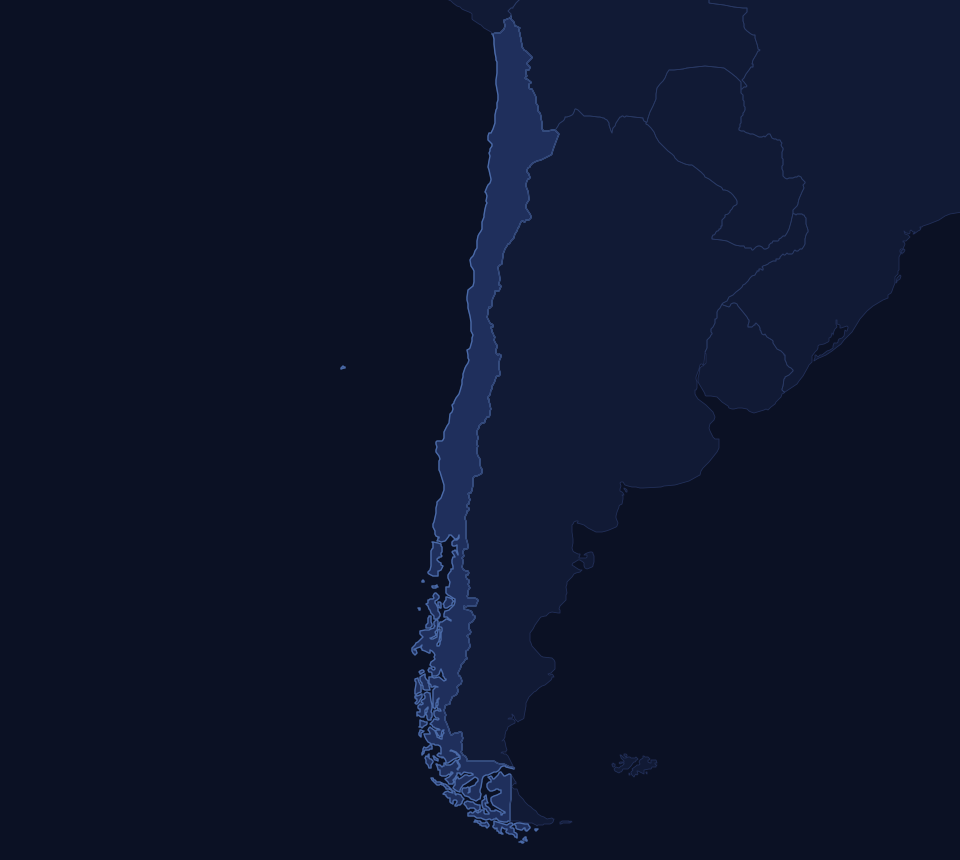
Green dots are observatories open to the public, blue dots research or private sites, squares dark sky places; select one for its page. See Observatories in Chile for the full list.
The coordinates on this page point to SOAR dome, Cerro Pachon: 30.238°S, 70.734°W.
Map data © OpenStreetMap contributors. Open the larger map · Directions. Mountain observatory roads are often gated after dark; go only on a scheduled public night.
Dark sky places, observatories and clubs near SOAR Telescope (Southern Astrophysical Research)
SOAR Telescope (Southern Astrophysical Research) is about 11 km (7 mi) from Gabriela Mistral Dark Sky Sanctuary, a Bortle Class 2 dark sky place. See Gabriela Mistral Dark Sky Sanctuary for camping, where to set up and the sky by season.
Nearest dark sky places
| Place | Where | Bortle | Distance |
|---|---|---|---|
| Gabriela Mistral Dark Sky Sanctuary | Vicuna, Chile | 2 | 11 km (7 mi) |
| Río Hurtado | Pichasca, Chile | 2 | 18 km (11 mi) |
| Bosque Fray Jorge National Park | Ovalle, Chile | 2 | 102 km (64 mi) |
Other observatories open to the public within 150 km
- Gemini South ObservatoryCerro Pachon, Coquimbo Region, Chile, 0 km (0 mi). Occasional organized visits via NOIRLab; no regular public night program
- Vera C. Rubin ObservatoryVicuna, Coquimbo Region, Chile, 2 km (1 mi). Public visits to Cerro Pachon by reservation through NOIRLab; spaces fill quickly
- Cerro Tololo Inter-American ObservatoryCerro Tololo, Coquimbo Region, Chile, 10 km (6 mi). Occasional public visits via NOIRLab programs; check site
- SMARTS TelescopesVicuna, Coquimbo Region, Chile, 10 km (6 mi). Free Saturday daytime tours of Cerro Tololo by reservation through NOIRLab/CTIO
- ESO 3.6m TelescopeLa Silla, Coquimbo Region, Chile, 109 km (68 mi). Part of ESO La Silla public visits (Saturdays; book ahead)
- New Technology TelescopeLa Silla, Coquimbo Region, Chile, 109 km (68 mi). Part of ESO La Silla public visits
SOAR Telescope (Southern Astrophysical Research) record
Every value in the observatories dataset for SOAR Telescope (Southern Astrophysical Research)
| ID | 105 |
|---|---|
| Name | SOAR Telescope (Southern Astrophysical Research) |
| City | Cerro Pachon |
| State | Coquimbo Region |
| Country | Chile |
| Continent | South America |
| Web | https://noirlab.edu/science/programs/ctio/telescopes/soar-telescope |
| Public | n |
| Telescope | 4.1m |
| Complex | CTIO Observatory |
| Parent | ESO |
| Elevation | 2738 |
| Lat | -30.2381 |
| Lon | -70.73372 |
| LatLonSpot | SOAR dome, Cerro Pachon |
| Status | Active |
| StatusNote | Consortium telescope managed via NOIRLab/CTIO |
| PublicNote | No regular public access |
| Sources | https://en.wikipedia.org/wiki/Southern_Astrophysical_Research_Telescope |
| GlobalParkID | 66 |
| ParkKm | 11. |
From the site's observatories dataset (observatoriesglobal_q426). Distances are computed from the coordinates.