
The Milky Way is a barred spiral of 100 to 400 billion stars, about 100,000 light-years across
| Type | Barred spiral, about type SBbc |
|---|---|
| Stars | 100 to 400 billion |
| Mass, with dark matter | About 0.2 to 1.5 trillion Suns; estimates still differ by a factor of several |
| Diameter of the stellar disk | About 100,000 light-years; thin outer stars reach 170,000 to 200,000 light-years across |
| Thickness of the thin disk | About 1,000 light-years |
| Central bar | About 30,000 light-years end to end, angled about 27° from the line to the Sun |
| Central black hole | Sagittarius A*, about 4.3 million Suns |
| Sun's distance from the center | About 26,700 light-years |
| Sun's orbital speed | About 230 km/s |
| One orbit of the Sun | About 225 million years |
| Escape velocity at the Sun | About 550 km/s |
| Age of the oldest stars | About 13.5 billion years |
| Nearest large galaxy | Andromeda Galaxy, 2.5 million light-years |
| Place in the universe | Local Group, Local Sheet, Virgo Supercluster, Laniakea Supercluster |
The mass is the least certain figure. Most of it is dark matter in the halo, and it is weighed from how fast stars and satellite galaxies orbit; measurements from the Gaia spacecraft since 2018 have pushed many estimates toward the low end of the range.
The Sun lies 26,700 light-years from the center, on the inner edge of the Orion Arm
The Orion Arm, also called the Local Arm, is a short arm or spur between the larger Sagittarius-Carina Arm inward and the Perseus Arm outward. The Orion Nebula, the Pleiades and the North America Nebula sit in it with the Sun; the Lagoon and Eagle Nebulae lie in the Sagittarius Arm, the Double Cluster and the Crab Nebula in the Perseus Arm. The Sun circles the center at about 230 km/s, once every 225 million years, and bobs up and down through the disk as it goes.
The Sun sits inside the Local Bubble, a hot, thin region about 1,000 light-years across blown out by supernovae over the last 10 to 15 million years. The Loop and Local Bubbles page zooms in from the Orion Arm to the Local Fluff around the Sun.
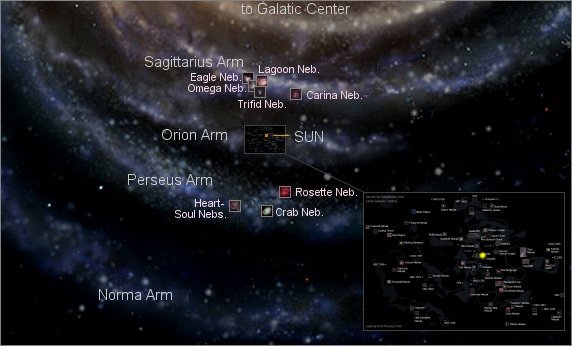
Four major arms wind out from the bar, plus the short Orion Arm where the Sun is
- Scutum-Centaurus Arm: starts at the near end of the bar and wraps around the far side; one of the two dominant arms.
- Sagittarius-Carina Arm: the next arm inward from the Sun, about 6,500 light-years away toward Sagittarius; the Lagoon, Eagle, Omega and Carina Nebulae lie in it.
- Orion Arm: the Sun's arm, about 3,500 light-years wide and 20,000 light-years long.
- Perseus Arm: the next arm outward, about 6,500 light-years away toward Perseus and Cassiopeia; the other dominant arm.
- Norma Arm and Outer Arm: one arm in most models, starting in the inner galaxy as the Norma Arm and continuing beyond the Perseus Arm as the Outer Arm.
- Near and Far 3-kiloparsec Arms: two short arms around the bar, about 10,000 light-years from the center.
Because the Sun is inside the disk, the arms cannot be photographed; they are mapped by measuring distances to young stars and gas clouds. The most precise distances come from masers, star-forming clouds whose radio emission lets the Very Long Baseline Array and Japan's VERA telescopes measure parallax across the galaxy.

At the center, Sagittarius A* holds 4.3 million Suns inside a region smaller than Mercury's orbit
Stars orbiting Sagittarius A* at up to thousands of km/s, tracked for 30 years at the Keck Observatory and the European Southern Observatory's Very Large Telescope, gave its mass; Reinhard Genzel and Andrea Ghez shared the 2020 Nobel Prize in Physics for that work. In 2022 the Event Horizon Telescope, which links radio dishes including ALMA in Chile, released the first image of its shadow. Around it lies the Nuclear Star Cluster, packed with millions of stars within a few light-years, inside a bulge and bar of older stars.
The center is in Sagittarius, near the spout of the Teapot, but dust in the disk dims its visible light by about 30 magnitudes; it is seen only in radio, infrared and X-rays.
The disk sits inside halos of old stars, hot gas and dark matter several times larger
- Stellar halo: old, metal-poor stars and about 150 globular clusters on orbits that loop far above and below the disk; Omega Centauri may be the core of a swallowed galaxy.
- Gaseous halo: hot gas at about a million degrees, reaching hundreds of thousands of light-years out.
- Dark matter halo: the bulk of the galaxy's mass, extending past most of the satellite galaxies.
- Fermi Bubbles: two lobes of gamma-ray glow about 25,000 light-years tall above and below the center, found by NASA's Fermi telescope in 2010; the larger eROSITA Bubbles, found in X-rays in 2020, surround them. Both are traces of an outburst from the center a few million years ago.
Streams of stars and gas record the small galaxies the Milky Way has torn apart
- Sagittarius Stream: stars pulled from the Sagittarius Dwarf, wrapped all the way around the galaxy.
- Magellanic Stream: a ribbon of hydrogen gas trailing the Large and Small Magellanic Clouds across more than 100° of the sky.
- Monoceros Ring: a band of stars around the outer disk, now usually read as a ripple or flare of the disk itself.
- Virgo Stream: a spread of halo stars in Virgo, probably debris from an old merger.
- Gaia-Enceladus, or the Gaia Sausage: a galaxy that merged with the Milky Way 8 to 11 billion years ago, found in 2018 from the stars' orbits in Gaia data; a large share of the inner halo came from it.
- Smith's Cloud: a hydrogen cloud about 11,000 light-years long, found by Gail Smith in 1963, falling toward the disk and due to strike it in about 30 million years.
The largest merger is still ahead. The Andromeda Galaxy is approaching at about 110 km/s; a merger in the next several billion years is likely, but a 2025 study using Gaia and Hubble data put the chance within 10 billion years at only about one in two.
68 known satellite galaxies orbit the Milky Way, led by the two Magellanic Clouds
Most are faint dwarfs found in sky surveys since 2005. The satellite galaxies page lists them all on a sky map, with magnitude, distance and which are still unconfirmed. The Milky Way, Andromeda and the Triangulum Galaxy are the large members of the Local Group.
The bright summer Milky Way is the view toward the center; the faint winter one looks outward
| Direction | Where in the sky | Best evenings | What you see |
|---|---|---|---|
| Galactic center | Sagittarius, near the Teapot | July and August | The brightest star clouds, the Lagoon and Trifid Nebulae, the Great Rift of dust |
| Along the Orion Arm | Cygnus | August to October | The Cygnus star clouds, the North America Nebula, the northern end of the Great Rift |
| Inward, southern sky | Crux, Carina and Centaurus | March to May | The Coalsack, the Carina Nebula, Omega Centauri |
| Galactic anticenter | Auriga, on the Taurus border | December and January | A thinner band through Auriga, Gemini and Orion, looking out of the galaxy |
| North galactic pole | Coma Berenices | April and May | Straight out of the disk: few stars, many galaxies of the Coma and Virgo Clusters |
The band shows its dust lanes and star clouds only under dark skies, about Bortle class 4 or darker, away from city lights and with no Moon. Find a dark sky site. Binoculars sweep up the star clouds; the Small Sagittarius Star Cloud, M24, is the best single field. For the core's hours month by month, and where the Magellanic Clouds can be seen, see how to see the Milky Way.